Power Outages: Drones to the Rescue

When the power goes out, KVS Technologies’ VP Services Håkon Kjerkreit is the first person utility companies call. He talks about how drones are used on the power grid as first responders in an emergency.

 How does KVS Technologies help utility companies during emergencies?

Winter is when most outages take place due to bad weather, and we have good capacity from our highly-trained pilots to mobilize for our customers. Mobilization either happens when the weather forecast looks bad and our customers want to take precautionary measures, or else after a problem has already occurred.

Is it stressful when customers call you up suddenly, asking for help within hours?

We operate differently in emergency situations compared to planned jobs, as we constantly need to adapt to changing information and priorities from the customers, depending on how the situation develops. Our operations team is used to handling situations that are in constant flux. When an emergency arises, our operations supervisor plays a central role in communicating with the customer and the field personnel. This is to provide the customer with the best possible situational awareness at all times, while making sure that data collection from the grid takes place as efficiently as possible.

Your drones fly pre-planned missions when doing routine inspections on the power grid. How do they work when trying to detect faults in an emergency setting?

Just as for our planned inspections, we prepare missions that the drones fly during emergency situations. Our job is to get the relevant data to the customer as quickly as possible. We are able to do emergency jobs with ease because of our experienced team, our robust drones, and our Grid Analytics software. Of course, back office support is also crucial during these kinds of operations.

The weather is cold, dark and can be nasty in winter. What safety considerations must you take into account when flying at this time of year?

To operate safely, we rely on our Minimum Equipment List, that states everything the pilot in the field shall have available to ensure safe execution of the mission. This includes items such as high visibility clothing, flashing lights on the vehicle, communication devices, and clothes to stay warm and safe. The operations supervisor also knows where our people in the field are at all times.

Are drone performance and data quality affected by the weather?

When the power grid is down, it is all about getting information back to the customer's emergency response center as soon as possible, no matter the weather conditions. Our drones are able to operate in low visibility conditions, such as fog and low clouds. This gives us the advantage of being able to operate even when helicopters can’t. We have seen on several occasions that our drones have been able to fly, whereas helicopters were grounded due to bad weather. Of course, the weather plays a role in the quality of our data, and this is true for all types of inspections. But in an emergency we are looking for large faults such as trees on the lines, and lines that have fallen down. In this instance, what matters more than the quality of the data is minimising the time from when the outage occurs, to when power is restored. 


How drone pilots stay warm in winter

Our drone pilots, or flight system operators as we call them, spend up to 30 hours a week outdoors when they are performing power grid inspections in the winter. While our engineers and developers are working indoors with central heating, those in operations unfortunately don’t have the same luxury. And we all know what Norwegian winters are like! So just how do our pilots stay warm when it’s freezing outside? We speak to three of them and find out all their tips and tricks.

Mette Nyås

‘When in doubt, wear wool underwear. It is always much colder than you think it will be! I know my colleagues use gloves, but I use thin wool liners so that I can still feel my hands when I use the remote controller for take-off and landing. Luckily we also have a kettle in our mobile command unit; I am dependent on instant soups and hot coffee to keep me warm!’

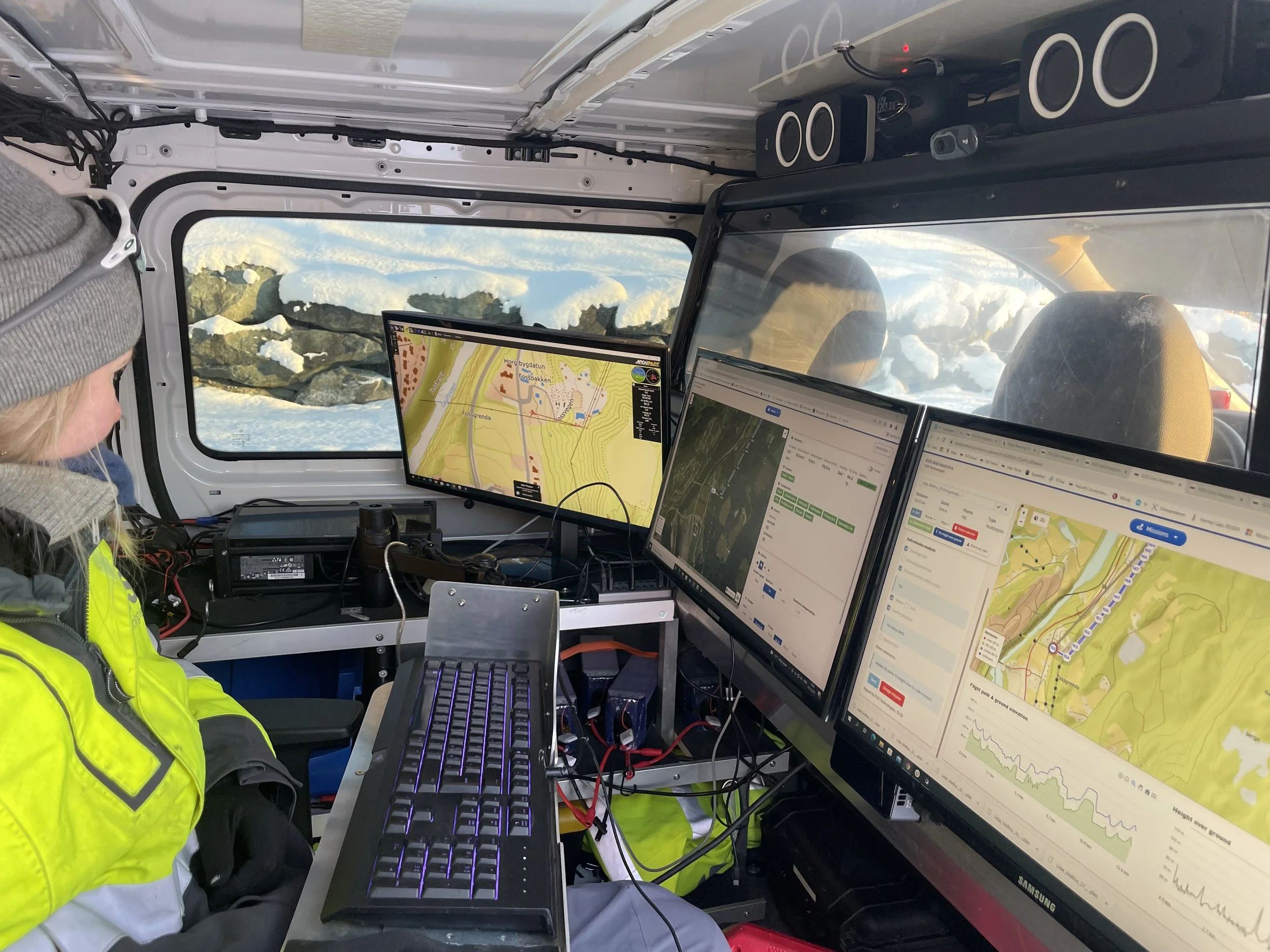
Mette inside the mobile command unit while the Explorer drone flies BVLOS over the power grid.

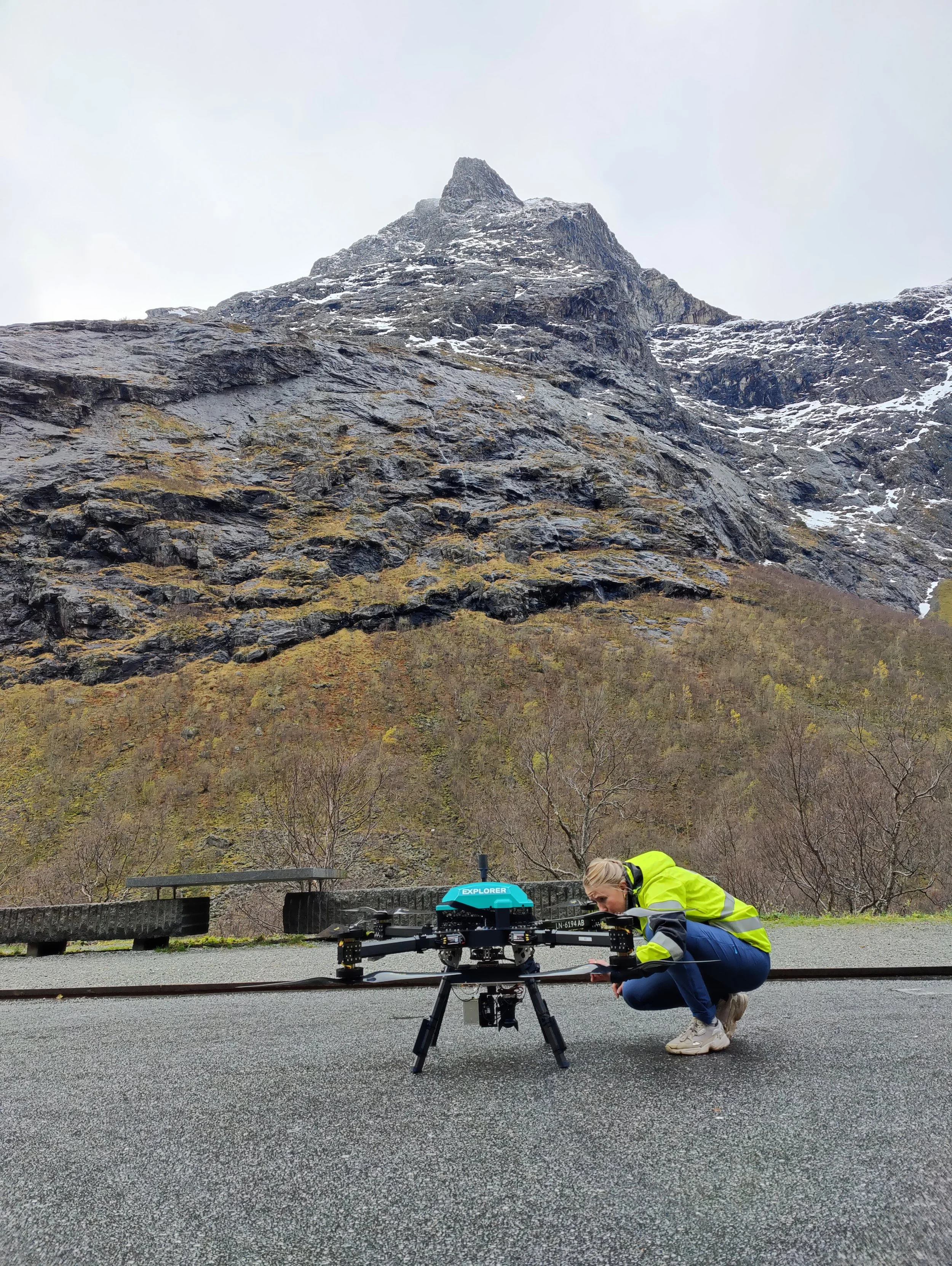
Mette doing a pre-flight check on a work trip to Trollstigen in early winter.

Thomas Haga

‘I have three kids so I’m used to being outdoors in the cold. But for me, winter time is really indoor time! If I have to go out in the field, I keep warm by not standing still, and wearing at least three to four layers of clothing, which includes wool and wind-resistant pants. Because our Explorer drone flies autonomously, we get to at least sit inside the mobile command unit most of the time! Then when I finally get back indoors after a long day, I grab a blanket and some hot coffee!’

Thomas spends his days testing our drones in close collaboration with our engineers.

Fredrik Lien Schei

‘I have lived in Trøndelag all my life, so I am used to the cold. The coldest it’s been while I’ve been working outdoors was just over -20 degrees Celsius. On a recent job I basically spent an hour crawling (and sinking) in two-metre deep snow for a distance of 100 metres, just to make sure that I had sufficient range and signal for the drone! With just six hours of daylight at this time of year, I try to be ready to go once the sun comes up, so as not to waste time. And even if I don’t freeze easily, I make it a point to overdress rather than underdress.’

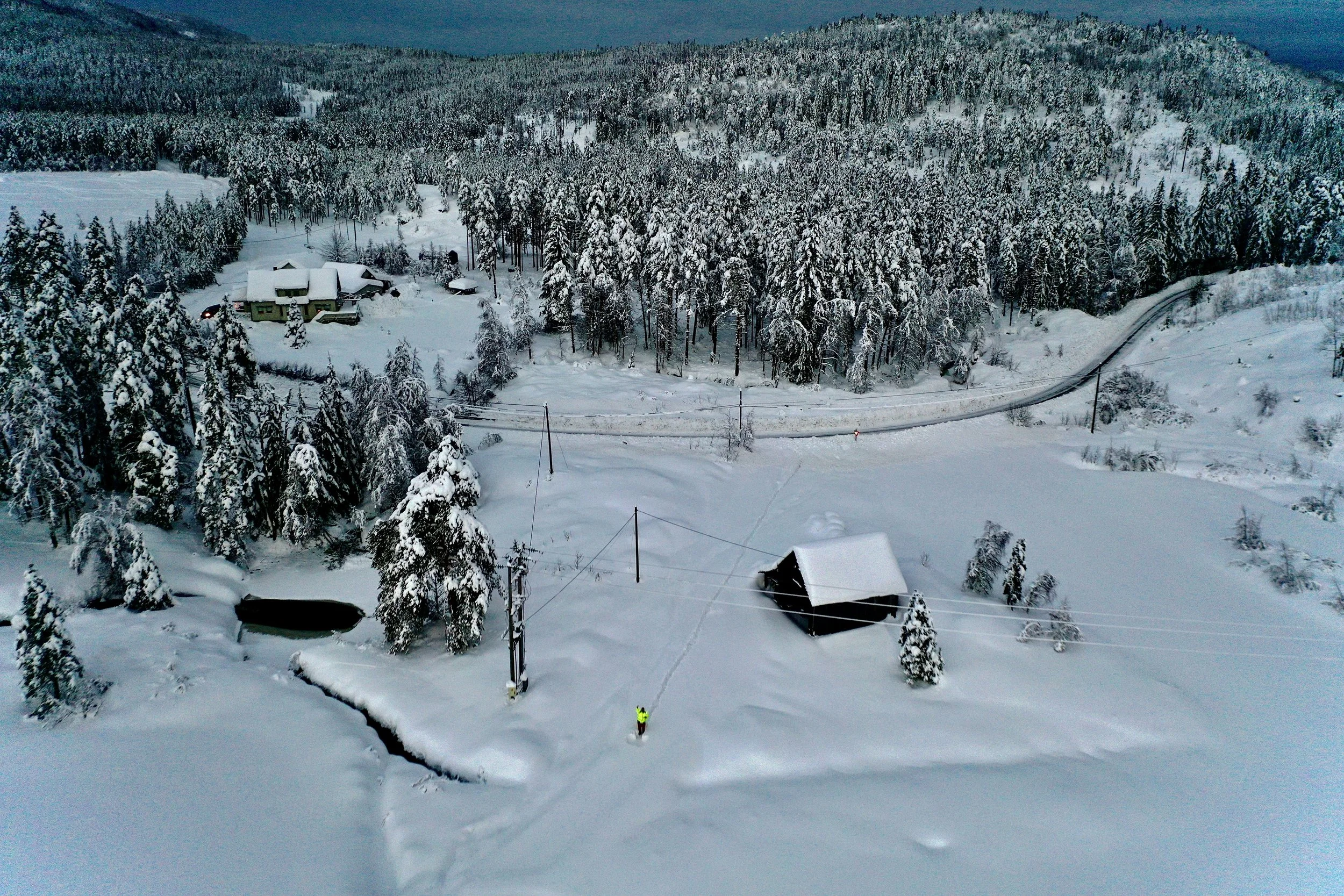
Fredrik waves to the drone while standing out in the open, pictured here during a customer job in Froland.

Mission Trollstigen: Avalanche Risk Analysis

If you’ve ever been to Trollstigen in Norway, you will have seen the famous road and its hairpin bends built into the side of a steep mountain. The entire area around it is full of majestic mountaintops – and at this time of year, they’re covered with white snow. In order to keep the roads safe, Statens Vegvesen (the Norwegian Public Roads Administration) has started to explore the possibility of using drones to collect laser data for avalanche risk analysis, and they recently invited several companies to participate. KVS Technologies and Terratec were proud to be among the handful of companies to conduct a demo.

The team that made the trip up consisted of head of mobile mapping Gunhild Mæhlum, drone pilot Mette Nyås, VP Services Håkon Kjerkreit and robotics engineer Marius Eskedal. The first day started with a briefing from Statens Vegvesen, where we learnt about the different risk factors that might cause an avalanche. These factors include depth of snow, density of layers, and temperature.

After the briefing it was time to get to work. We had to fly at three different sites as Statens Vegvesen wanted to see the different types of lidar data that each company collected in each area. Test area A was a forest and grass covered area with Ground Control Points; this was set up to inspect the quality of data. Test area B was for testing the systems in extremely challenging terrain. Lastly, test area C represented a likely scenario – a mountain covered in snow.

The weather was especially bad at the third site – it was windy with strong gusts, which reached its worst just as we were landing our drone. But our pilot Mette did a fantastic job – she kept the drone stable in the air despite the turbulent weather, and we were able to land safely after collecting the necessary data.

The data: (L-R) 3D modelled terrain of test area B, shaded relief of Digital Terrain Model (DTM) - test area C, and a colour map of snow accumulation calculated based on the deviation between our survey and the existing NDH (national detailed height-model) - test area C. There was only slight snow cover on the day of our data capture, accumulating up to 1m in some areas.

Good mission planning and utilizing the combined competences at KVS Technologies and Terratec allowed us to obtain satisfactory data coverage of even the vertical rock cliff at test area B. Terratec’s sophisticated tools for georeferencing data also made operations very smooth. The raw data was ‘shipped’ to the office through a cloud service immediately after the survey, and initial results of processed point clouds were made available through our web portal Mapspace only a few hours later. The results have since been sent to Statens Vegvesen for review.

Natural high: Mette, Gunhild and Håkon are all smiles at Rampestreken.

We are grateful for the opportunity to meet other companies and witness all the different technologies out there – and for the rare chance to gather people in our organisation who don’t often get to meet! ‘Visiting Trollstigen with my new colleagues and experiencing the synergies of the KVS Technologies/Terratec merger hands-on was a great experience,’ says Gunhild.


Power to All Our Friends

KVS Technologies’ big time supporters Brage Johansen and Grethe Skundberg interview each other about the fragility of the power grid, autonomous systems, and public scepticism.

Photo: Thomas Haga/KVS Technologies


Grethe Skundberg: We’ve been fellow board members in KVS Technologies since 2017. How did you first get involved?

Brage Johansen: Back then, I was the co-founder and CEO of Zaptec, where we installed charging infrastructure for electric cars and worked with the electrical grid from a consumer standpoint. That was when I learned that the power grid is actually very fragile. Then I met Cato Vevatne and the fantastic group of young engineers who were making robots to monitor critical infrastructure. Since then, I have been involved in KVS Technologies. What about you?

Grethe: I was involved with Nordic Unmanned in their early days when they started to compete with helicopter companies for power grid surveillance, and I had my first meeting with Cato, Håkon (Kjerkreit) and Steffen (Solberg) in 2017.  It was not difficult to say yes to a board position. Their vision, enthusiasm, knowledge, competence and eagerness was inspiring. Since then, I have been involved and following the company closely, and I’m impressed by the team and its speed in becoming a cutting-edge developer and first mover. What a journey! So now you’re the CEO at Heimdall Power, which provides utility companies with solutions so they don’t get to the point where they need to call in resources for emergency preparedness. Why is this close to your heart?

Brage: The power grid is a massive infrastructure – in fact it is mankind’s largest machine – and our whole civilisation is dependent on it. Even more so now in the green shift to implementing new renewable power sources and electrifying society. Improving and optimizing the power grid is essential for our future success.

Photo: Thomas Haga/KVS Technologies

Grethe: Although Heimdall Power and KVS sell their products and services B2B, the benefits have positive consequences for the people on the street. Tell me more about these.

Brage: We depend on electricity for all civilised things we want to do. We do not need more outages or blackouts; that is one of the reasons to monitor the grid. Improving the power grid that we have today, instead of building new grids, will also lower the electric bills of every person. Wouldn’t you agree?

Grethe: For sure, and even more than saving money, it makes our electricity more stable and therefore more trustworthy.  Heimdall Power and KVS Technologies are in the same boat, trying to provide utility companies with insights and helping them to increase grid capacity. These sound like perfect solutions, given that electrification is taking place and the world is racing to reduce emissions by 2030. What’s still standing in your way though? 

Brage: For one hundred years the power grid has worked just fine. It was designed and shaped by Edison, Tesla and Westinghouse around 1900. A grid owner always built in extra capacity and did not care to observe or monitor the grid before a fault happened. Now everything has changed – mostly due to more extreme weather which radically changes the energy production patterns, consumption behavior, and the performance of the grid itself. The power grid is such a big system that we need robots and sensors to monitor it. But the main barrier to implementing modern, automated, intelligent solutions is tradition and conservatism in a very old industry. You’re very interested in unmanned systems yourself – what makes you sure that an autonomous solution can be trusted? Especially in an emergency situation, where the stakes are high?

Grethe: Fifteen years ago when I was doing communications at NATO, they were using robots to detect bombs. A lot of military technology has since been commercialised, such as drone technology. I learned that using autonomous systems will reduce risk and make operations safer and more cost effective, while reducing the environmental footprint.  Autonomous systems will only get better and attain higher TRL (technology readiness levels) as we move forward. KVS Technologies has entered a segment that will and must evolve for the good for everyone; in fact they are already at the forefront of this segment.

Brage: As the communications director at Kolumbus, you’re in the business of critical infrastructure, and your job is to shape messages that go out to the public.  How should companies like Heimdall Power and KVS Technologies be communicating to the (thankfully) small number of people who feel threatened by the idea of data collection for greater insight, or the use of unmanned systems to improve operations?

Grethe: Mankind has always been afraid of the unknown, including new technology. We must acknowledge the scepticism and communicate to address that. We have to ‘show and tell’. When the first car was introduced in the 19th century, a police officer walked in front of it with a red flag to warn people that it was ‘dangerous’. When Kolumbus implemented the first driverless bus in mixed traffic in Norway in 2018, we did the same with a yellow flag. The world is constantly moving forward and progressing. In 2018 the GDPR (General Data Protection Regulation) law that regulates data collection data was introduced. That was a huge and important step, because it assured people that their personal data was not being misused. Companies like Heimdall Power and KVS Technologies must discern if the public are afraid their jobs might disappear, or if it’s general scepticism towards new technology. It is not difficult to show and tell that both companies will launch new jobs, while helping us to reduce cost as well as blackouts on the power grid – which we are all dependent on!

A Proposed DAA System for Low Altitude BVLOS Flights in Mountainous Terrain

The use of commercial drones, or unmanned aerial vehicles (UAVs), is on the rise around the world. According to the FAA’s 2017-2037 Aerospace Forecast, there could be as many as 1.6 million commercial drones in the sky by now. The main risk associated with UAVs is the absence of a pilot onboard who can make the right decisions in an emergency situation. This could endanger the lives of manned traffic in the air and third parties on the ground. Therefore, UAVs in airspace must be able to detect and identify the world around them, decide on potential collision risks, and take the appropriate maneuvers to avoid such collisions. To do this, they need a reliable Detect and Avoid (DAA) system.

There are already many off-the-shelf DAA systems around the world designed for low altitude (500 feet and below) beyond visual line of sight (BVLOS) flights. There are also DAA systems for drones flying at high altitudes (500 feet and above). However, there is currently no DAA system suitable for low altitude BVLOS flights in mountainous terrain where continuous flight maneuvering is required – which is what KVS Technologies needs. In this type of terrain, even if a DAA system were to detect other aircraft, the valleys would not be wide enough for an avoidance maneuver and carrying out such a maneuver would result in a "sudden encounter".

Currently, each country has its own U-Space service provider that allows drones to fly in the same airspace as other traffic. In Norway, the U-Space service provider is Avinor. Although they are aware of the issue, it is unlikely that a DAA system for drone operators like us can be developed in the short term.

On the other hand, even if the SORA (specific operation risk assessment) methodology and accompanying documentation does not impose any system for detection of air risks, it recommends that a system is to be installed to achieve an adequate level of detecting risks and collision avoidance.

This prompted us to come up with a proposed model that will allow us to conduct our low altitude operations in accordance with the existing airspace traffic management regulations. This would not just benefit us, but also other drone operators in the same situation as us.

KVS Technologies is proposing a DAA system that is made up of two parts. The first is the detection system, used in correspondence with real-time aircraft navigation application Air Navigation Pro (ANP). In addition to this, KVS Technologies’ drone pilots will be able to see any manned air traffic during flights using a first-person view (FPV) camera. This allows them to perform avoidance maneuvers that are within the framework of maneuvering procedures determined by our Flight Operations Manager and Flight Systems Technical Manager. Global flight tracking service Flightradar24 is also used during flights in order to detect other traffic who use Automatic Dependent Surveillance–Broadcast (ADS-B) instead of ANP. With these three components in place, the drone pilot will be able to detect almost all traffic.

The second part of the DAA system is the avoidance system and it comprises five components:

First-person view (FPV) camera

Using the forward-facing FPV camera mounted on the drone, any traffic coming into the flight path of the UAV can be monitored. If any traffic would interfere with the planned flight path, the appropriate maneuvers can be carried out in accordance with the flight procedure.

This follows the aviation rules stated in '’Forskrift om luftfartøy som ikke har fører om bord mv 4(d) and (49)’’ and SORA Tactical Mitigation Performance Requirement. 

Air Navigation Pro (ANP)

This application calculates the direction and speed of the flight vehicles detected in a defined area, for example our planned drone flight route or take-off area. Avoidance manoeuvres can be performed, or the drone flight can be put on hold until the traffic is clear of conflict. In addition, our drone flight is coordinated by contacting the relevant airspace controller via VHF radio.

 Notice to Airmen (NOTAM)

A NOTAM is published for the area we intend to fly in, at least 12 hours before the flight. This ensures that the relevant traffics cross over the altitude specified in the flight area, or coordinate their flights with our flight crew if a flight will be performed inside of our flight zone.

Anti-collision and position lights

During BVLOS flights, drones are required to be equipped with position lights and a strobe light that produces at least 20 flashes of more than 10 candelas. This ensures that the drone flight can be observed by other aircraft flying at low altitudes.

Flashing lights on control unit (CU)

If a flight is performed with other air traffic in the same local airspace, flashing lights on the CU shall be used so that other traffic in the same airspace will be aware of the drone operation.

The work KVS Technologies is doing on this DAA system includes many stakeholders such as Avinor, AirNavigation, helicopter companies, and potentially other drone operators – coordination work between these parties has already commenced. There are however certain challenges associated with installing a DAA system. Since it is a new system, there are possible risks that existing components do not work well together. In addition, it can be expensive to adapt this system to a drone, especially when taking into consideration training, test flights, and the investment of time and other resources. Nonetheless, we hope that our DAA system will meet all DAA requirements, become widespread throughout Norway, and help all aircraft, especially those performing low flights, to be able to detect each other and prevent accidents in the air.

KVS Technologies and Spright's first meeting in person!

Fantastic five: From left to right — Justin Steinke (Spright’s VP of Operations), Jimmy Bostrøm (KVS Technologies’ COO), Maribeth Forst (Spright’s Director of Engineering Solutions), Joe Resnik (Spright’s CEO) and Cato Vevatne (KVS Technologies’ CEO).

In late October, Cato and Jimmy flew to Houston for the Energy Drone and Robotics summit. This was momentous not just because it was their first time travelling internationally since the pandemic started, but also because they finally got to meet the Spright team in person! Back in September it was announced that KVS Technologies had signed a US$60 million deal with Spright for power line inspections in the US – both parties had worked very closely for months, but only via Teams meetings!

Drone talk: Justin Steinke and Cato Vevatne during a panel discussion on BVLOS power line inspections.

The Spright team that was in Houston consisted of Joe Resnik (CEO), Justin Steinke (VP of Operations) and Maribeth Forst (Director of Engineering Solutions). KVS Technologies and Spright had a joint booth at the summit, and Cato and Justin also co-hosted a panel discussion about KVS Technologies’ power grid inspections in Europe, which garnered a lot of positive attention. BVLOS operations have not been allowed on a commercial scale in the US, with most UA operations being conducted within visible line of sight (VLOS), so everyone at the summit got a taste of what’s to come.

It was also very interesting to see the different drone suppliers at the summit – both fixed wing and multicopter – and many of them boasted solid industrial design that really made their drones stand out. There were also several hydrogen powered drones. One thing Cato and Jimmy agreed on was that they needed to get a Boston Dynamics ‘Spot’ dog as soon as possible!

Welcome home: Jimmy, Cato, and Joe tour the Air Methods headquarters in Denver.

After the summit in Houston ended, Cato and Jimmy took a two-hour plane ride to Denver, the home of Air Methods (parent company of Spright). They had a couple of very productive days there together with the Spright team. One of the items on the meeting agenda was the type certification for KVS Technologies’ Explorer E30, which Spright will use exclusively to conduct power line inspections in the US. Opportunities in the US market, which is 50 times larger than the Norwegian market, were also discussed. Several utility companies in the US have already expressed significant interest, and both KVS Technologies and Spright are incredibly excited about what lies ahead.

To make up for the lost travel in the past 18 months, Cato and Jimmy embarked on a whopping 24 hour journey to get home, taking them from Denver to Houston to Amsterdam and finally to Stavanger. The jetlag left them feeling like zombies – which was very convenient since they landed just in time for Halloween!

The world’s first BVLOS power line inspection in an airport’s control zone?

Runway success: The KVS Technologies mobile command unit and drone at Kjevik airport, while a plane approaches the runway in the background.

This fall, KVS Technologies inspected 500km of power lines for Agder Energi Nett inside Kjevik airport’s control zone (CTR), which to our knowledge is a world first when it comes to completing a grid inspection inside an airport’s control zone. This was a huge milestone for us and for the aviation industry, as we were able to prove that drones can be operated beyond visual line of sight (BVLOS) safely inside controlled airspace, over an extended period of time. The job took place over three days, with a total flying time of around 13.5 hours.

The controlled airspace around an airport covers a wide area that can extend out to 20km, with vertical limits from the ground up to 3000 feet (914m). This is called a control zone, and all air traffic (planes and helicopters) must establish and maintain radio communications with the tower. Traffic that intends to enter this airspace must request clearance from the air traffic controller (ATC) to enter this airspace. Drones that want to operate BVLOS inside the CTR must also submit a request to ATC before they intend to fly there.

Reporting for duty: The team from KVS Technologies that was working on the operation at Kjevik airport comprised a supervisor and two drone pilots, one of which was Aleksandra Ness (pictured).

KVS Technologies approached SERCO, the ATC operator at Kjevik airport, 14 days prior to the planned operation, to give them ample time to consider our intentions. We explained how communications before, during, and after our flights would be performed. In addition we attached images of our intended flight paths and info on the maximum altitudes we were going to fly. Another important part of the planning process was to familiarize ourselves with the airspace and relevant charts for the airport. In particular the Visual Approach Chart was used, as this is the same chart used for aircraft flying by visual flight rules during good weather conditions.

There were important considerations to be made before starting operations in the CTR:

-The possibility of air ambulances heading from the airport to Kristiansand hospital (or the other way round), as they have priority due to the urgent nature of their mission

-Multiple power lines crossing the extended centerline of Kjevik airport’s runway, and also in the vicinity of the airport

-General aviation activity in the form of helicopters flying low, as well as small airplanes exiting or entering the CTR or operating in the vicinity of the airport

As with all KVS Technologies operations, a supervisor was monitoring the progress of the flights at Kjevik airport, and notified ATC both when our drone was ready for flight, and also after it had landed. The supervisor used internal communication channels and available online resources to monitor air traffic in the area, while keeping an open line to ATC as well as the drone pilot.

KVS Technologies received very positive feedback from SERCO upon completion of the operation in the CTR. SERCO praised KVS Technologies for completing the task on time, and also for the seamless interaction between supervisor, pilot in the field, and ATC.

Our operation proved to be successful and all our intended flights were performed safely without any incidents. We would like to thank SERCO and Avinor for their flexibility and patience, and Agder Energi Nett for trusting our capabilities. We look forward to continuing our cooperation in the future.

Have you heard of power line inspections being carried out with BVLOS drones in airport control zones anywhere else in the world? If yes, we’d love to hear about it! Tip us off here.

What Does a Test Pilot Do at KVS Technologies?

It’s a warm and overcast day in August, and Martin Ringstrøm is enjoying the view from his office for the day: a bright green field dotted with wildflowers, somewhere in Sandnes.


As a test pilot at KVS Technologies, Martin plays a very important role in supporting both the operations and R&D teams. He tests the drone systems and uses his experience and competence to make sure the drones are safe for operations, and also provides feedback on how they can be improved. One day he might be doing post-maintenance verification flights, and another day he might be working closely with the engineers to increase the performance of future versions of the system. Regardless of the type of test being performed, each drone flight requires the test pilot to follow stringent flight test procedures.

Today, Martin is testing a new motor on a drone, which is a relatively simple task. Since the test location in Sandnes is close to the airport, he conducts all flights here within visual line of sight (VLOS). Normally he conducts most of the test flights on Tau, where he can perform large-scale drone testing beyond visual line of sight (BVLOS), in order to ensure that everything is safe and sound before the drones are released for use in commercial jobs.

Test pilots like Martin must have aerospace experience or knowledge of other high-tech systems, in addition to electrical or mechanical assembly skills. Great communication skills are no less important, since he has to work closely with all members of the organisation. The last time he was out flying, he had a robotics engineer with him so that manual fine-tuning of the drone could be done after each round of test flying. On another occasion, a software engineer was out here with him, writing code in the back of the mobile command unit so that changes could be made to the software in real-time.

KVS Technologies - Test pilot -3.jpg

KVS Technologies is now looking to hire a new test pilot to join the team. Visit our Careers page if you’re interested in finding out more about the role!


What a service provider for the utilities is doing about the new EU drone regulations: Part 2

By Selcuk Yilmaz, Compliance Manager, KVS Technologies

At KVS Technologies, we have ambitions of scaling our operations and carrying out autonomous power line inspections for utility companies all over Europe. Since the EU regulations for drones were changed earlier this year, we have been working on evaluating compliance to the operations safety objectives (OSOs). The level of robustness to be proven for the different OSOs is determined by the results of our SORA (specific operation risk assessment) assessment. Our operations are classified as “medium risk” , more accurately as SAIL (Specific Assurance and Integrity Levels) IV. In addition, both organizational and relevant documents are being prepared for obtaining a Light UAS Operator Certificate (LUC). The privilege of obtaining this will be self-authorized operations without having to apply for any additional authorization.

(Part 1 of this blog post described what drone operators in the EU have to do in light of the new EU drone regulations. Click here to read it.)

Each process has many steps in it, but we are fortunate that KVS Technologies has a solid team of highly-qualified technical personnel and experienced pilots with aviation backgrounds. For instance, Jone Fredriksen our Continuing Airworthiness Manager and Technical Authority Flight Systems has the responsibility of making sure the flight systems are designed, built and maintained in order to ensure safe operation of the flights systems. At the same time he makes sure the flight systems are compliant with relevant standards. Stian Helgesen our Flight Operations Manager manages and monitors the aircraft operational activities to make sure they take place in accordance with the Civil Aviation Act, and he stays on top of all the permits, approvals, and operational documentation. I myself am the Compliance Manager, and I am in charge of making sure we follow aviation rules, tracking standard changes, and checking compliance with the current system.

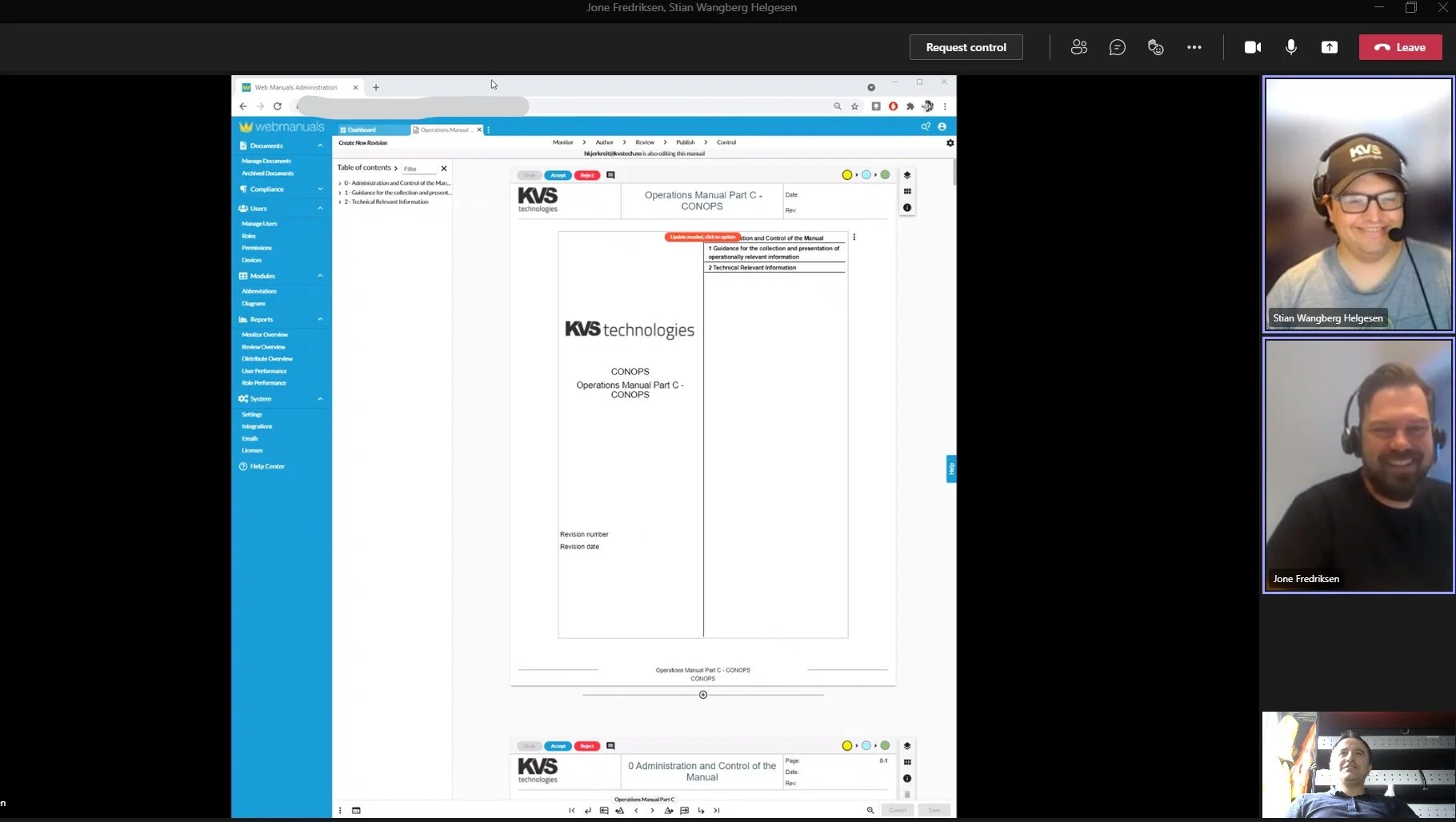
Team Work: Stian, Jone and myself during one of our many online meetings, working on the Light UAS Operator Certificate (LUC) to send to the Civil Aviation Authority (CAA) in September. We are using Web Manual’s Document Control System.

Team Work: Stian, Jone and myself during one of our many online meetings, working on the Light UAS Operator Certificate (LUC) to send to the Civil Aviation Authority (CAA) in September. We are using Web Manual’s Document Control System.

Recently, the three of us met with the Civil Aviation Authority (CAA) in Norway to discuss secure risk management. One of the items we had on the agenda was to present the research I am doing in my three-year PhD program at the University of Stavanger, where I am specializing in risk management in drone flights. Since the aim in drone operation preparations is to determine the security and safety risks of the operations and to take technical and operational mitigation measures, it is important for KVS Technologies to raise the bar here.

One of the important research areas in my doctoral studies is the establishment of a DAA (detect and avoid) system that will meet KVS Technologies’ requirements. Our beyond visual line of sight (BVLOS) flights are mostly in mountainous areas that require constant maneuvering at low-level altitudes, and to date there isn’t a DAA system for operators like us. Our first step is to test the usability and airspace compatibility of different DAA systems at Tau Autonomy Center, which is a training center for autonomous vehicles and remotely controlled systems.

We also discussed the work we’ve recently completed on a risk model that is valid in both the Federal Aviation Administration (FAA) and European Union Aviation Safety Agency (EASA) regions. All issues in the SORA (specific operation risk assessment) method and the FAA Order 8040.4B document on Safety Risk Management Policy were investigated in detail. Thanks to this risk model, safe flights based on risk management that will be accepted in both the FAA and EASA regions will be possible. The CAA received this positively, which we were happy about.

A second meeting with the CAA was set up to discuss the necessary type certification (TC)/design certification for the drones which we intend to fly in the FAA and EASA regions. The main issue that has puzzled us is the compatibility of documents and verification processes between the FAA and EASA. Thankfully this meeting was enlightening and it became clear to us that applications for design verification should simply be sent directly to EASA.

These are just some of the many things we’ve been doing in the last weeks and months, and our plan going forward is to send the LUC and SORA documents to the CAA in September. It’s been a long process, but the new rules will benefit the drone industry by allowing for safer integration of drones into the airspace. They will also benefit KVS Technologies by allowing us to operate all over the EU according to a standardized set of rules. Obtaining the new LUC – besides allowing us to fly without authorisations each time – will mean that our organizational competence, technical capacity and operational capability have gotten the stamp of approval from the aviation authorities. This is important when it comes to assuring our customers that we  are a professional, qualified supplier that puts flight safety first. We look forward to the day our drones are all over Europe, helping even more utility companies inspect their grids in a safer, greener and smarter way.

What a service provider for the utilities is doing about the new EU drone regulations: Part 1

Lines and legislations: KVS Technologies provides autonomous power line inspection services to utility companies, and the change in EU drone regulations at the start of 2021 has meant that many things have had to be adapted in order to comply with the new rules.

Lines and legislations: KVS Technologies provides autonomous power line inspection services to utility companies, and the change in EU drone regulations at the start of 2021 has meant that many things have had to be adapted in order to comply with the new rules.

New regulations regarding risk-based drone flights in the EU came into effect on January 1 this year, causing hundreds of anxious drone operators — including us, a service provider for the utilities that uses drones for autonomous power line inspections — to turn their eyes to the European Union Aviation Safety Agency (EASA).

Before the changes were made, drone operators carried out their flights in accordance with the rules set by the aviation authority in their own countries, bearing in mind that once they flew across national borders they would be subject to different rules. What was permissible in one country was not necessarily permissible in another country.

For example, while drone operators in Portugal had to use drones weighing less than 25 kg and possess third-party limited liability insurance of up to 1 million euros, the same rule did not necessarily apply next door in Spain.

This difference had caused confusion and was unfortunately stalling drone adoption in the EU. So the EASA decided to standardize the rules in order to reduce the risks that drones may pose in the air or on the ground to a minimum level, making the European skies a safer place to fly.

Distinctions will no longer be made between flying drones for leisure or for commercial operations. Factors like weight of drone, drone specifications, and the certificate based on type of operations have now come into focus.

So what happens in the EU now?

The new regulations that apply to all drone operators in the EU are 2019/945 and 2019/947.

In Regulation 2019/945, requirements for unmanned aircraft systems were reintroduced, and designers, manufacturers, importers, and distributors must meet these requirements to obtain conformity markings and monitor the market for safety and performance. In short, drone manufacturers will put forward fail-safe or independent redundancy measures to bring their technical specifications within the acceptable safe risk limits.

With Regulation 2019/947, pilots and operators face new rules and procedures for the use of unmanned aerial vehicles (UAV). These pertain to things such as education, crew response management, flight regulations, Crisis Response Plan (CRP), etc. Operators must begin to adopt risk-reducing measures for the specifications of the drones and the operations they will perform.

However, these security targets are difficult to comply with. For this reason, drone operators agree that it is more practical to implement the STS (standard scenarios) determined by EASA and to adhere to the predefined safety considerations for these scenarios.

Risk-based assessment: The different levels of complexity

For VLOS (visual line of sight) drones flying commercially in the Open category, the low level of risk and the relevant class identification requirements from C0 or C4 are considered sufficient to gain approval from the authorities. On the other hand, the requirements set in STS 1 or 2 are expected to be met for drone operators flying in the Specific category in class C5 and C6.

For BVLOS (beyond visual line of sight) flights, there are two different risk assessment methods. The first is to follow the PDRA (predefined risk assessment) method for short-distance flights. In order to fly long distance, four PDRAs are produced within the scope of the EASA regulations – one for VLOS flights and the remaining three for BVLOS flights. These are really good reference guides for drone operators performing BVLOS flights, but even if the requirements set out in the PDRAs are met, the BVLOS flight distance is nonetheless dependent on the presence of an air observer or the designated ‘restricted area’ distance. This would impact the BVLOS flight distance by shortening it considerably.

The second method for BVLOS flights is to follow the SORA (specific operation risk assessment) method for long-distance flights. SORA came to the aid of drone operators who conduct long-distance operations, by not imposing a flight distance limit. However, SORA demands a high level of integrity and assurance level, which is not quite easy to meet. Depending on their type of operation, drone operators flying long-distance must fulfill the SORA requirements depending on their Specific Assurance and Integrity Levels (SAIL).

Accompanying the SORA process, EASA has made it possible for drone operators to operate more freely thanks to the introduction of the Light UAS Operator Certificate (LUC). This is a corporate approval certificate that allows an organization to self-authorize operations within an approved ‘Concepts of Operations’, without applying for additional authorization for each operation type. Drone operators may request this certification from the National Aviation Authority, and their organization and internal processes will be evaluated to demonstrate that they can assess the risk of an operation themselves. The requirements to be demonstrated by drone operators are defined in Part C of Regulation 2019/947 (EU). However, this certificate is valid in the “home country” only, but since the certification basis is the same in all EASA countries, the operator can apply for a LUC in the other countries using the same means of compliance.

It’s clear that even as the EU hoped to make drone operations easier and safer for everyone, the process of adapting to the new rules has brought about a multitude of challenges. Drone operators have had to adapt their drone systems, make organizational changes, and reorganize risk minimization tools according to their types of operation. Recognising that these new rules will take time for organizations to implement, EASA decided to postpone them by a year, meaning that the regulations only come into effect on January 1, 2022.

‘The utility industry is slow to adopt new technology’ 

Eric Bitzko heads the unmanned aerial vehicle (UAV) program at Pedernales Electric Cooperative, the largest distribution cooperative in the US. In this candid interview, he lets us peek into his world, all the way over in Johnson City, Texas. 

Air time: A drone inspects the lines for maintenance and reliability. Photo: Pedernales Electric Cooperative

Air time: A drone inspects the lines for maintenance and reliability. Photo: Pedernales Electric Cooperative

From Norway to the US, more and more utility companies around the globe have started using drones on their power grids. Whether it’s linemen stashing small drones in their toolkits to help diagnose problems in hard-to-reach areas, the large-scale use of autonomous drones to inspect the entire grid, or a strategy that lies somewhere in between, one thing is clear: Drones improve efficiency. And yet the sad fact remains that the utility industry is still lagging behind other industries when it comes to implementing new technology. 

Pedernales Electric Cooperative (PEC) was considered one of the industry’s early adopters of drone technology when they started their internal UAV program using visual line of sight (VLOS) drones in 2015. Their grid in Texas has 23,000 miles (just over 37,000km) of power lines across an area of 8,100 sq miles (21,000 sq kilometres) – and they’re out flying every single day.  

Their pilots capture data, their line inspectors look for discrepancies on the grid, and their crew execute repairs. Results have been spectacular – since the program began, their outage duration has reduced by an hour, or 60 per cent. (In the US, they use a metric called SAIDI, or System Average Interruption Duration Index.) Pretty impressive, considering that they started with just two guys and a Phantom 2. 

‘We now have two full-time pilots with more capable systems. We have also trained some of our linemen to fly smaller drones to give them additional capability in the field. In total, we have about 25 licensed pilots throughout PEC, with more in the pipeline to get trained,’ says system maintenance supervisor Eric Bitzo. 

Advocating for drones: The man fronting the unmanned aerial vehicle (UAV) program at PEC is system maintenance supervisor Eric Bitzko. Photo: Eric Bitzko

Advocating for drones: The man fronting the unmanned aerial vehicle (UAV) program at PEC is system maintenance supervisor Eric Bitzko. Photo: Eric Bitzko

Eric has plans to scale the drone operations at PEC, but acknowledges that the industry is still figuring out new ways to use the tools, as well as the data. The more drones are used, the more knowledge we can generate. ‘However, the utility industry as a whole is slow to adopt new technologies. There is still pushback in the industry from the folks that think ‘We have done it without UAVs for a hundred years’,’ he says. ‘The ROIs we are seeing are incredible so it’s not necessarily a performance issue, in my mind it’s a culture issue. Luckily that mentality is slowly changing through attrition.’ 

KVS Technologies: Can you tell us about the impact that your drone program has had on your reliability metrics, and ultimately on your cost savings?  

Eric Bitzko: We started off with a SAIDI number of 108 minutes, and we closed out 2020 with around 42 minutes. By having the ability to quickly and efficiently inspect our distributed assets and route crews to only the poles that are in need of maintenance, we have been able to successfully improve our overall system performance by over an hour of SAIDI. That’s a pretty significant feat for a Coop with over 355,000 meters on the system. The ROI of that can be measured with the Department of Energy’s Interruption Cost Estimator. It provides a formula to be able to extrapolate a dollar figure from the improvements in reliability. Unfortunately I can’t get into specifics but I can say that the ROI is well over 30 times our investment – not to mention member satisfaction goes up when they aren’t sitting in the dark as often or as long with a teenager who can’t charge their phone! 

Even more important than the numbers is safety. Are there any real-life anecdotes you can share that demonstrate the benefits of using drones? 

Back in the beginning of our program, one of the use cases that we first experimented with was flying a pull line across the flooded river to restore power. It worked well so we repeated it another handful of times during that particular event. The benefit of having the ability to fly the line across the river was you no longer had to put a grunt in a kayak to cross a still-flooding river, an obvious improvement in safety over some of the legacy methods. As for the more day-to-day operations, there is a significant decrease in hazardous man hours required to inspect our infrastructure. With less exposure there is less of an opportunity for something to go wrong. The other benefit is that we are able to cover ground much faster with the UAV platforms. This allows us to inspect more of our system much more frequently to find and fix problems before they turn into failures.  

You’ve mentioned that you want to use a more data driven approach moving forward. Tell us more about this. 

The systems we operate in this industry produce a lot of data. Being able to tell the forest from the trees is the first step in ironing out what data is pertinent to increasing reliability on the grid. There are really four pillars to reliability: Weather, equipment, vegetation and animals. Since NASA won’t let me play with their weather machine you have to focus your efforts on the last three. The good news is though that by improving the last three you begin to impact the first, by building into your grid a resiliency to weather.  

You have your obvious data points like outage data and metering data that give you a good starting point. Fault data can help you decipher the type of fault and match up that data to the outage itself, to help you understand modes of failures and what items you need to focus your UAV inspections on.  

The other data that will help understand health of the system is the pole test and treat data. Where poles are at in their lifespan and what poles are reaching the end of life can give you an insight into the age of that specific section of the grid. Those are the sections of the grid that you can focus your maintenance efforts on to extend life of that infrastructure or begin the planning and projecting of capital projects to rehabilitate that section of line.  

With smart grid projects becoming more widely adopted, another data point that I think adds to the insight of the system is device telemetry.  Trip logs and oscillography can be layered into the data sets to add even more depth to the understanding of what the system is doing. Before you know it you have painted yourself a pretty detailed picture of where you can focus the efforts of your inspection crews, and with the improved workflows utilizing UAVs as a corner stone, you now have some very impactful projects that again are driving the reliability metrics and KPIs in the right direction.    

Lined up: With the success of the internal UAV program at PEC, Eric Bitzko has plans to scale the drone operations further. Photo: Pedernales Electric Cooperative

Lined up: With the success of the internal UAV program at PEC, Eric Bitzko has plans to scale the drone operations further. Photo: Pedernales Electric Cooperative

The lifetime expectancy of a lot of the components on your grid has likely passed, but it takes time and money to upgrade. How has your drone program and the data that comes with it changed your perspective on your maintenance strategy? 

We touched on that a little bit with the last question but you’re right, there is some legacy framing out there that has been fully depreciated. The advantage of being able to quickly collect information on those sections of lines is you can start making better decisions on what can be replaced and what just needs a little TLC to extend the life of the structures. The trending data that comes from those inspections allows you to better plan what projects need to be done sooner than later and what can be pushed one, three or five years down the road. Prioritizing infrastructure upgrades and rehabs allows you to better utilize capital funds and be more impactful on the grid itself.   

You met our CEO Cato Vevatne when you were co-panelists at a digital conference. What shared ideas led to you both hitting it off? 

Not being intimately familiar with each other’s programs beforehand, we ended up having a lot of parallels in our approaches from different sides of the world, which was really interesting. The hurdles we had to overcome and how we navigated those hurdles were very similar, which is always good to hear. Cato has a vast amount of experience and I really appreciated the passion he brings to the table in driving the industry forward, refining approaches, and ultimately building a better mouse trap to serve the industry.  

What is the biggest misconception that people have about using drones on the power grid? 

The biggest misconception is that people think drones are stealing jobs, which couldn’t be farther from the truth. We have actually hired more crews to make repairs because we implemented UAVs into the work flow. We have seen that on average, one drone crew can keep four maintenance crews busy 50 hours a week. Being able to produce a high resolution picture of the exact problem in the exact location is a much more efficient way of approaching maintenance. They aren’t wasting time going to locations that aren’t in need of repair and because of that are covering much more ground than they otherwise would have utilizing traditional legacy methods of inspection. Maintenance cycles are much shorter, which means we are improving reliability for more members than ever. This allows us to minimize the time ambient conditions have to impact our system in between inspections, which as you can see has significantly improved our SAIDI metrics.  

As a thought leader in the industry, what question do you wish people would ask you - but they never do? 

The one I do get less often is ‘Where do you see the industry heading in the future?’. I think that with technology outpacing regulations we already have more capability than the law will allow, which is a good place to be. In the future you will see grid operators that have the ability to fly their entire systems daily and the AI to digest that data just as fast as we can fly it. But in order to get there, us grid operators need to complete at least one cycle through our system to re-establish a baseline condition of the grid. That will minimize the amount of discrepancies that are found each day to a level that is manageable by the crews making the repairs. I also think that you will have the automated drones linked up with protective devices. As soon as a fault occurs on the system an automated flight plan is produced and executed. The data is livestreamed back and post-processed in near real time. That triggers other automated systems like a delivery style warehouse drone that is delivering the correct material directly to the location and the self-driving bucket truck delivers the lineman to the correct location with the correct material ready to go to make the repairs. Like I said we are a ways off from that reality but it’s fun to think about the capabilities.  

What ‘KVS Green’ means to KVS Technologies CEO Cato Vevatne

A moment in the hot seat: To KVS Technologies CEO Cato Vevatne, being green starts with knowing what the environment means to you and taking little steps everyday to live in a more sustainable way.

A moment in the hot seat: To KVS Technologies CEO Cato Vevatne, being green starts with knowing what the environment means to you and taking little steps everyday to live in a more sustainable way.

If you’ve been following us on social media for a while, you’ll have seen splashes of bright green, or what we call ‘KVS green’. It’s such a special shade of green that it even has its own hashtag, #kvsgreen. The origin of this colour dates back to late 2019, when we gave our brand a little facelift. We wanted a new corporate colour that represented who we are: a young, innovative team working on a greener and safer solution for inspecting power grids all over the world.

Tomorrow (June 5) happens to be World Environment Day, a day that is set aside to encourage global awareness and action for our environment. Their theme this year is ‘Reimagine, Recreate, Restore’. The message that is being spread on this day resonates with us at KVS Technologies, because we see that the work we do makes an immediate positive impact on businesses. Every single time a utility company chooses to use an autonomous drone instead of a helicopter, significant changes are made. No more jet fuel. No more unnecessarily risking the lives of people onboard an aircraft. No more disturbance to wildlife.

No one lives and breathes this more than our CEO Cato Vevatne. As the face of KVS Technologies, he is never not talking about a safer, greener, and more efficient way to do power line inspections. So in the spirit of World Environment Day, we ask him where his motivations come from, and what KVS green really represents for him.

Growing up here in Norway, when did you become conscious of the environment as something that we needed to protect?

As a young boy I loved the sea and the mountains (and I still do). Seeing litter out in nature or other signs of visible pollution has annoyed since I was very little. It harms our planet, and on top of that it also looks terrible. It surprises me that some people just throw their waste in nature as if was the most natural thing to do, as if they just didn’t care.

What is it that you feel most strongly about, when it comes to the way the world is living now?

The ‘use and throw’ culture that is prevalent today bothers me. I believe in quality over quantity. Instead of buying a lot of stuff, it would be better if we bought less and focused instead on buying things that actually last. It would make a huge difference if people just consumed less in general!

How do you try to live in a greener, more sustainable way?

I try to support local businesses who manufacture their products locally, since that boosts the local economy and reduces the need for transport. I often say no to plastic shopping bags and bring my own reusable bag when I go to the supermarket. I make an effort to reduce plastic waste, for instance by not using plastic straws or cutlery. I reuse and take good care of my possessions so that they may last a lifetime – maybe even generations. I also have a habit of picking up garbage if I see any lying on the ground.

The use of KVS Technologies’ drones offers multiple benefits ranging from better data to increased safety. Would you say that ‘less emissions’ and ‘working greener’ are the most important benefits to you? If so, why?

This is like asking a parent to pick their favourite child! The best thing about our technology is that it makes the world slightly better on several different levels. It’s better for the environment – drones reduce emissions directly by replacing helicopters, and indirectly by decreasing downtime on the grid, which means more efficient power delivery and less use of alternative power sources when the grid goes down. It’s better for the power consumers due to reduced cost and more uptime. It eliminates the substantial risk associated with the way traditional inspections are being done, which is by climbing or by helicopter flights.

How do you feel the work you do at KVS Technologies contributes positively to nature and the environment?

I feel that we are contributing everyday by providing utilities worldwide with a better and more sustainable way to do their asset management and infrastructure inspections.  

Be sure to follow us on Linkedin, Facebook and Instagram for more #kvsgreen content! Links in the footer at the bottom of this page.


Drones uncover grid errors after power outages in Sirdal

The weather in Norway in late January was not kind to say the least – many places around the country were experiencing extreme weather ‘Frank’ and the power outages that lay in its wake. KVS Technologies had been wrapping up an emergency response job for a utility provider on the eastern part of Norway on January 22 when they got a call from another electricity company, Agder Energi Nett. The snow was bucketing down in Sirdal, an extremely popular area for weekend cabins located about an hours’ drive away from KVS Technologies’ headquarters in Stavanger. The power grid was down, thanks to the snow and ice that had built up on the lines. Over 3000 customers were affected by power outages, and the mobile network was also down in some areas.

On the road: Selcuk Yilmaz from KVS Technologies standing on the snow-covered road leading to Sirdal.

On the road: Selcuk Yilmaz from KVS Technologies standing on the snow-covered road leading to Sirdal.

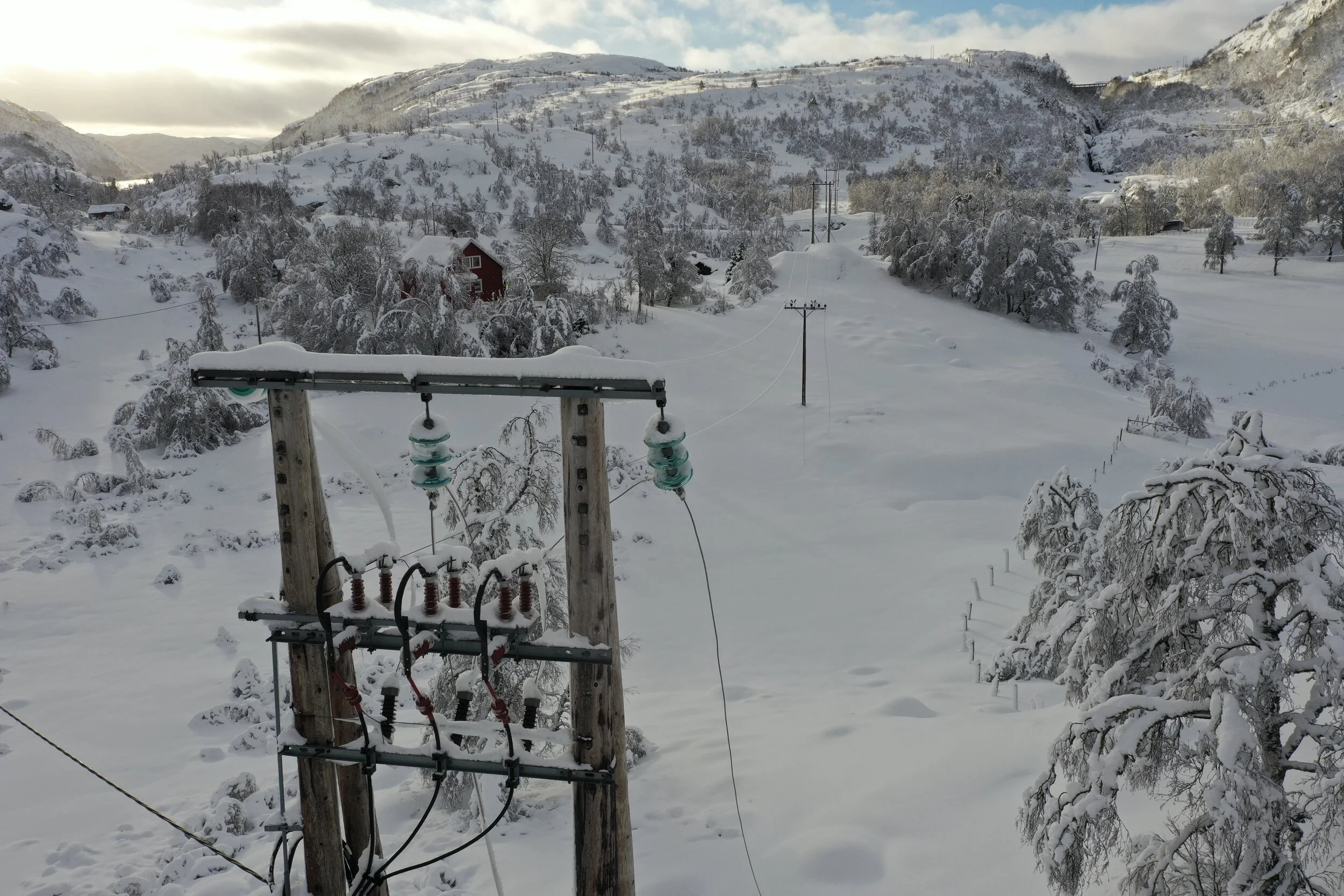
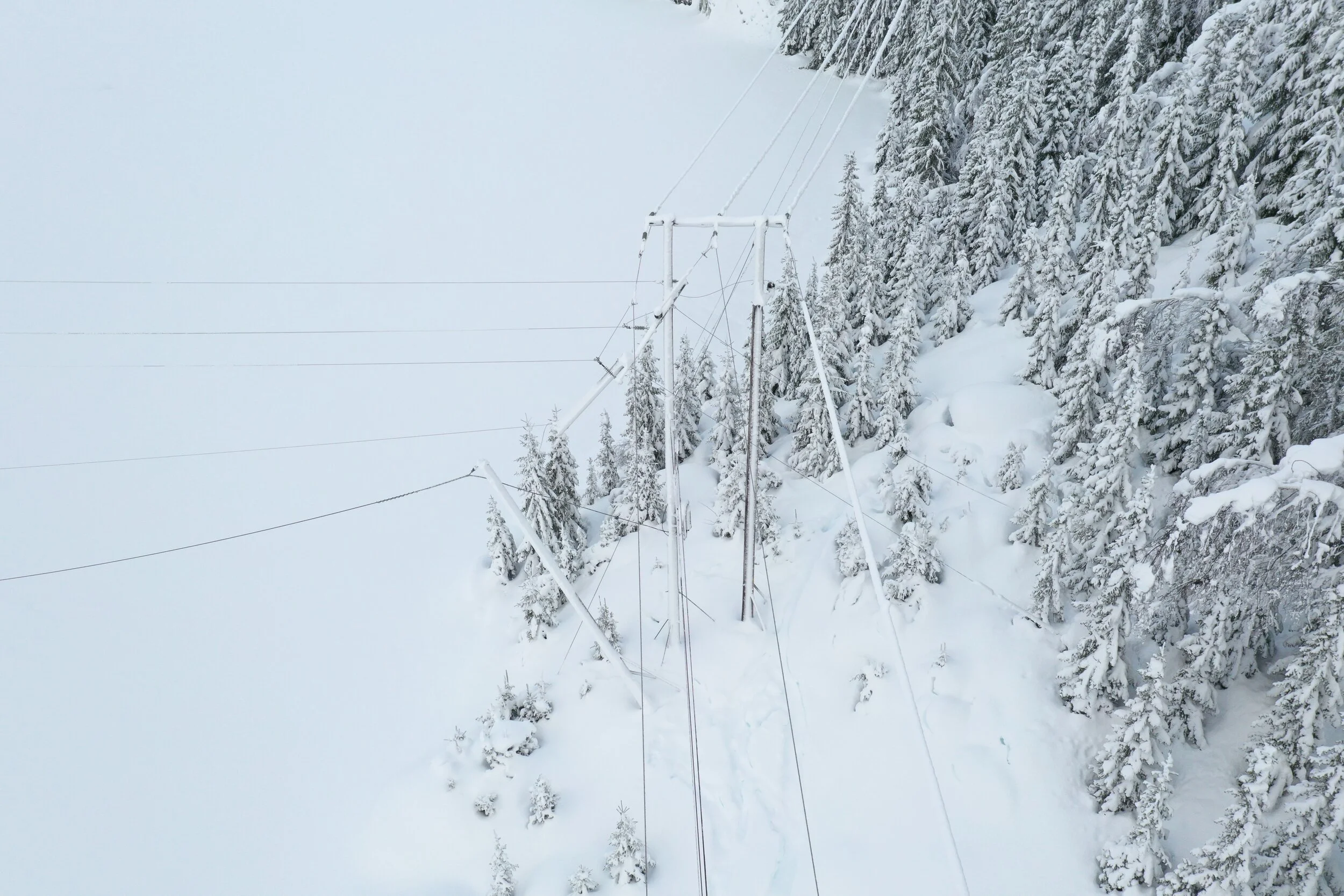
KVS Technologies’ VP of Services Håkon Kjerkreit promptly assembled another team for mobilization at first light, and they swiftly loaded their drones into their vehicle. Compliance Manager Selcuk Yilmaz was part of this team. ‘Snow-covered roads reduced our speed a little in getting to Sirdal, but once we were there we quickly found some of the problems. One mast had broken and fallen on another pole, causing a power outage. We also discovered two power lines north of Sirdal that had broken and were touching the ground. We promptly provided Agder Energi Nett with our data, and their technicians were able to address these issues,’ he says.

Broken lines: This drone image shows two power lines that had broken and which had come into contact with the ground.

Broken lines: This drone image shows two power lines that had broken and which had come into contact with the ground.

Since finding all grid faults and restoring power was a top priority for Agder Energi Nett, they also had helicopters operating at the same time. In order to minimize risks in the air, sectoral separation was provided. ‘At first the helicopter flight was delayed due to poor visibility caused by fog formation and snowfall. But because it was important to detect errors and report them to Agder Energi Nett as soon as possible, we got to fly our drones in the sector allocated to helicopters,’ says Selcuk. ‘Once the weather conditions improved, the helicopter traffic started up again. We then reconnected with them via VHF radio and reported our location and activity. These practices allowed us to fly safely in a narrow flight area in coordination with helicopter traffic.’ Thanks to the efforts of all involved parties, power was fully restored to all the affected households in Sirdal by the evening of January 23.

KVS Technologies - Agder Energi Nett - Beredskap 3
KVS Technologies - Agder Energi Nett - Beredskap 4

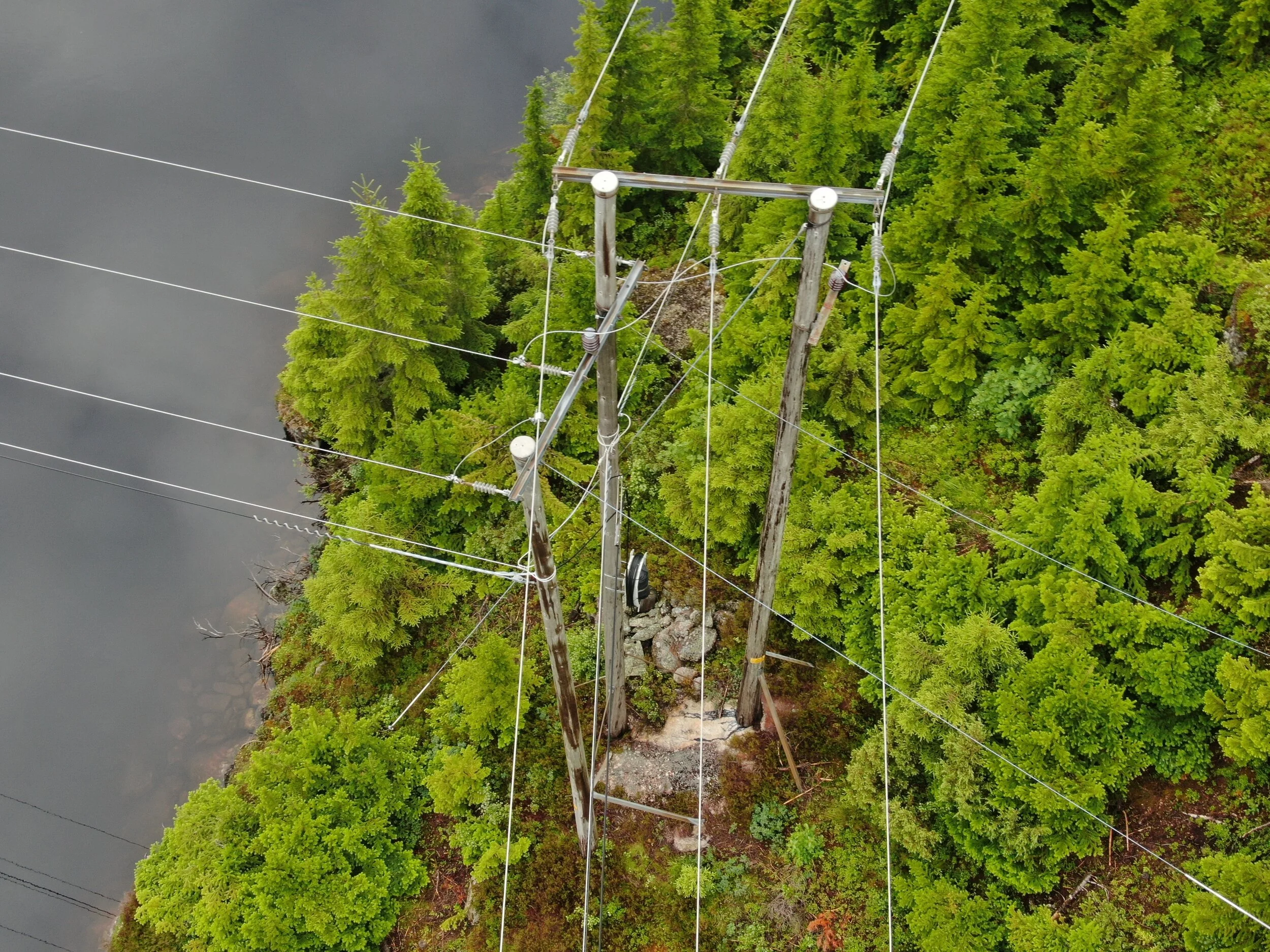
Agder Energi Nett has utilised KVS Technologies’s drones for power line inspections before, but this was the first time they were used in an emergency response project. The image on the left above, taken during a routine line inspection in July 2020, shows how the mast used to look before it got damaged in the snow (above right). This example illustrates how historic data of the grid can allow utility companies to compare the condition of their grid over time, enabling them to perform condition-based maintenance in non-emergency situations. But for now, the value of using drones to swiftly find critical errors in the event of an unforeseen power outage has been demonstrated.

‘Our team was the first aerial asset on site, as the inbound helicopter was stopped by bad weather. With our system we were able to deliver real time information from the grid to Agder Energi Nett’s emergency response center, and they were thus able to send their technicians on the ground to fix the issues,’ says Håkon Kjerkreit.

If you’re from a power company, how has historic data previously helped you in your maintenance programs? Tell us about your experience by dropping us a note here.

Power Outages: What Goes On Behind the Scenes

In the days just after Christmas 2020, while many people had taken time off work and were relaxing on their couches, heavy snow started to fall in the eastern part of Norway. The winter landscape was pretty and all, but as the snow continued to fall, tree branches started to get weighed down. Unable to bear the extra weight, some trees toppled completely over power lines. Power lines also started sagging under the weight of accumulated snow and ice. Suddenly the power was out in thousands of homes. The worst hit ones had no electricity – which means no heating – for hours.

Winter wonderland: Elvia’s power grid was covered in snow, which was pretty to look at despite the chaos it caused. Photo: Mette Nyås

Winter wonderland: Elvia’s power grid was covered in snow, which was pretty to look at despite the chaos it caused. Photo: Mette Nyås

Norwegian newspaper Aftenposten reported that power company Elvia was working day and night to restore power, and that they had mobilized extra personnel for troubleshooting. As part of their emergency response operations, they sent helicopters up into the air to inspect the power lines. With the need for all hands on deck, Elvia also used drones from KVS Technologies, a provider of autonomous power line inspections. At the same time, they had technicians out on the power grids, fixing whatever problems the helicopters and drones could find.

 Mette Nyås, a 23-year-old drone pilot at KVS Technologies, was celebrating Christmas with her family in central Norway when she got the phone call. Elvia’s power lines were down, many customers were affected by outages, and they needed help. That same day, she said goodbye to her family and got into her car, heading for Nordmarka in the eastern part of Norway. The 8.5 hour journey ended up taking her 10 hours due to the slippery roads. But the weather conditions were just as demanding once she was on-site. There were only six hours of daylight, so it was a race against time. The roads were snowed in, and Mette struggled to get as close to the powerlines as she could for drone take-off.

Portrait of a lady drone pilot: 23-year-old Mette Nyås was out operating KVS Technologies’ drones on Elvia’s power grid, looking for the problems that had caused power outages. Photo: Mete Nyås

Portrait of a lady drone pilot: 23-year-old Mette Nyås was out operating KVS Technologies’ drones on Elvia’s power grid, looking for the problems that had caused power outages. Photo: Mete Nyås

When snowfall was at its heaviest, the helicopters were grounded due to poor visibility. But once they were back up in the air, this presented yet another challenge in the emergency response operations – ensuring the safety of both the drone and helicopter operators, and of course, that of all third parties on the ground. Sharing the same air space presents risks, and drones have to yield to helicopters. Good communication between both parties was essential, as well as with airport operator Avinor and the NOTAM (notice to airmen) office.

‘We experienced just how much effort and coordination goes into an emergency response project, not just from us, but also from Elvia, the helicopters, and other vendors. There were a lot of people working, even over Christmas, to make sure that everyone had power at all times,’ said Mette. ‘We also saw a lot of potential in using drones in emergencies like this, especially when the weather was too challenging for anything else to operate.’

Stein Orrem, leader of the operations center at Elvia, was happy with the data provided by KVS Technologies’ drones. ‘Due to heavy snowfall we experienced outages in our grid going through forest landscape. We needed to investigate the conditions and since helicopters were not an option because of low visibility, drones were the answer. We contacted KVS Techologies, and they helped us with the inspection. We received clear drone pictures which pointed out problems with trees leaning over the power lines. Thanks to KVS Technologies, we were able to remove potential threats and avoid new outages,’ he said.

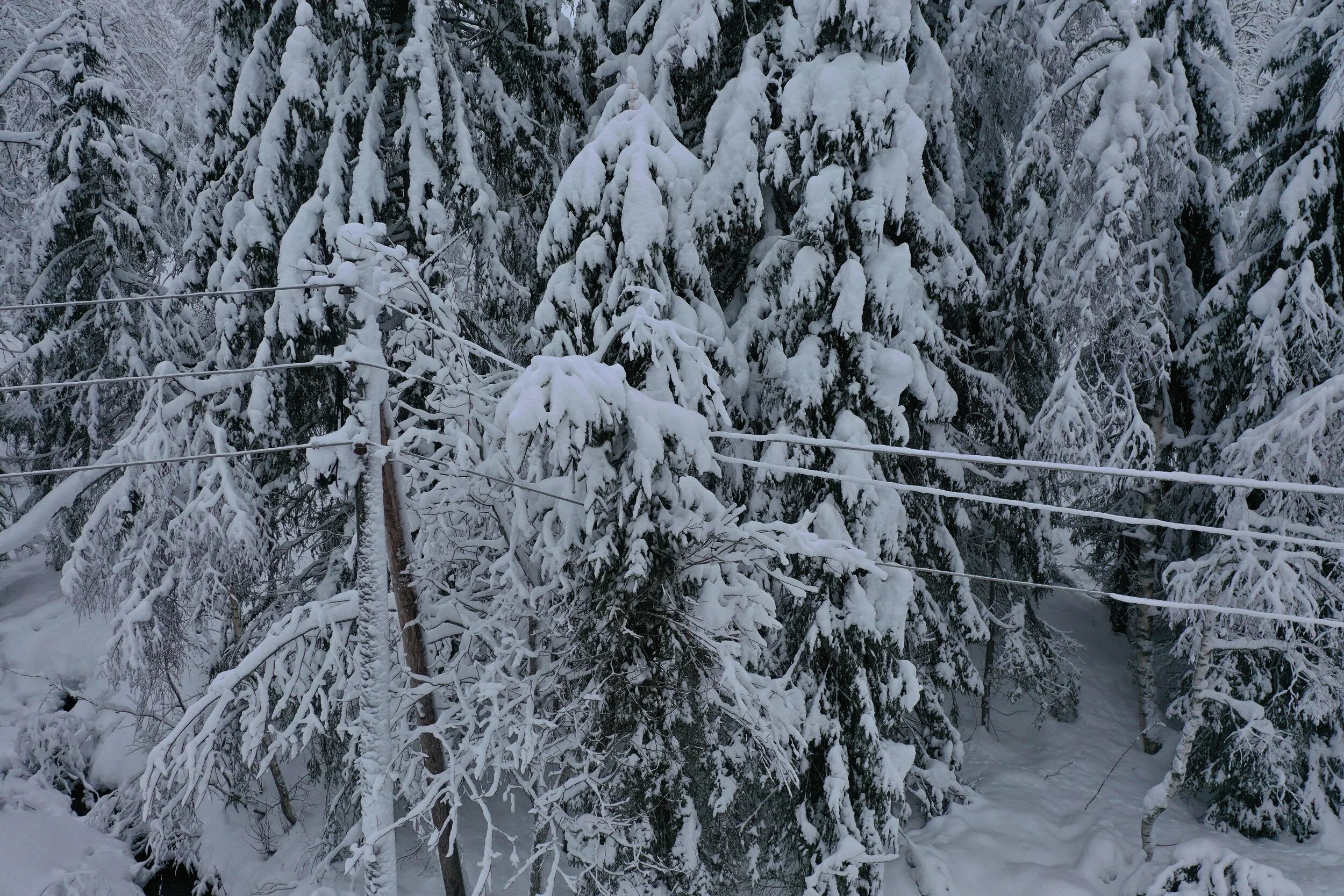
Snowed under: This is one of the photos captured by KVS Technologies’ drones, showing how trees weighed down by snow had come into contact with the power lines. Photo: KVS Technologies

Snowed under: This is one of the photos captured by KVS Technologies’ drones, showing how trees weighed down by snow had come into contact with the power lines. Photo: KVS Technologies

With more heavy snow and strong winds forecasted in the middle of January, Mette and her teammates from KVS Technologies found themselves back in the eastern part of Norway to continue supporting Elvia. The utility provider had already increased its resources on their operations and customer service teams, and Mette’s team operated drones to uncover any potentially vulnerable areas, in an effort to prevent large-scale power outages.

‘We also re-inspected the same powerlines again to see if there was more snow build-up. Nordmarka is a very populated area, so it’s important to monitor if the power lines get too close to the ground, since that can create dangerous situations,’ said Mette. Elvia had issued an advisory to the public asking people to avoid power lines that hang low or have come into contact with the ground. People were also asked to not try and remove snow from the power lines themselves – any problems should be reported directly to Elvia here.


Were you one of the households in Nordmarka who were affected by the power outage? Share your experience with us here.

New Year, New Drone Regulations

New EU regulations for drones have come into effect since January 1, 2021. Here’s what you need to know.

How it works: There are now three new categories for drone operators, regardless of whether you fly for private or commercial purposes. Photo: Civil Aviation Authority Norway

How it works: There are now three new categories for drone operators, regardless of whether you fly for private or commercial purposes. Photo: Civil Aviation Authority Norway


What this means for hobbyists: Gone is the distinction between leisure and commercial flights. As long as you own a drone – even if you only use it for taking scenic photos in your free time – you are considered an operator and you will need to register with the National Aviation Authority of the EU country you reside in. The only exception is if your drone has no camera and weighs less than 250 grams or is CE-marked as a toy. If your drone has a camera or weighs over 250 grams with payloads, then you must also take an online course and exam with the National Aviation Authority of your country. Depending on which Open sub-category you fall into, there might be associated costs. These new rules will apply across Europe. Read more about the regulations here.

But why is this happening? Your drone might be small and you might think of it as a completely innocuous object, but the fact is that flying it is not without risk. Think about how every time a drone sighting around an airport can cause total chaos with flights being rerouted and delayed. Considering that the vast majority of drone flights take place in the same airspace as manned flights, and that the use of drones is increasing exponentially around the world (both privately and commercially), a better system is needed to control all air traffic and lower the risk of collisions. To safeguard the future of aviation, the European Union Aviation Safety Agency (EASA) has decided to implement more robust rules.

And how does this impact commercial businesses? The year 2021 will be a transition year for commercial operators, who will need to make adjustments in order to comply with the new rules. For us at KVS Technologies, we go over from the old RO3 license to the ‘Specific’ category. But first, we need to pass a risk assessment and receive approval from the authorities. Over the course of this year, we will need to revise our flights procedures and technical issues according to the SORA (Standard Operations Risk Assessment) risk parameters in order to make our BVLOS (Beyond Visual Line of Sight) operation even more reliable. We’re not stopping there – reducing our accident tolerance to zero also involves efforts to further strengthen our drones’ technical capabilities, and reinforce our maintenance procedures.  There will also be greater focus on training to increase the theoretical and practical skills of the flight crew who plan and perform the flights.

A long list: For KVS Technologies, complying with the Civil Aviation Authority Norway’s new rules doesn’t just stop at passing tests and getting approval — it also involves ensuring that their drones are at the top of their game.

A long list: For KVS Technologies, complying with the Civil Aviation Authority Norway’s new rules doesn’t just stop at passing tests and getting approval — it also involves ensuring that their drones are at the top of their game.

What we think about the changes: ‘The new rules are aimed at reducing the risk of accidents in the air and the damage to third persons on the ground. Yes, drone performance is improving day by day, but this doesn’t negate the importance of having skilled and trained drone pilots who have quick reflexes in emergency situations,’ says Selcuk Yilmaz, Compliance Manager in KVS Technologies. ‘This is why drone pilots must undergo theoretical training, take exams, conduct training flights, and pass various flight tests – just like helicopter or airplane pilots. At KVS Technologies, our pilots have all the necessary competencies, taking into account the flight rules and pilot training standards determined by EASA.’

What do you think of the new EU drone regulations? And how have they impacted you? Share your thoughts with us here.

Drones replaced helicopters in the inspection of Skagerak Nett’s entire power grid in Hjartdal municipality  

Postcard from Hjartdal: This image was captured by KVS Technologies’ drone, showing an overview of the powerlines and also the picture-perfect scenery from Telemark.

Postcard from Hjartdal: This image was captured by KVS Technologies’ drone, showing an overview of the powerlines and also the picture-perfect scenery from Telemark.

Earlier this autumn, KVS Technologies successfully completed a drone inspection of Skagerak Nett’s high-voltage power grid in Hjartdal municipality. This was the first time that one of Norway’s largest utility companies had used drones to replace helicopters in inspecting an entire municipality’s grid. (Read the full press release here.)

The entire grid comprising 1206 masts was inspected by fully-electric drones, and according to Morten Gøytil, Maintenance Manager at Skagerak Nett, the job was done just as quickly as if they had used helicopters. The data captured by the drones was instantaneously available to Skagerak Nett in real-time, and the customers were happy with the results. ‘The captured documentation from the drones gave us very good insights to asset health and uncovered faults that needed immediate action. The drones completed the job as fast as helicopters would have done, while providing greater safety for our crew, better documentation, and less noise pollution,’ said Gøytil.

Hole in one: Needless to say, these situations are not desirable! Photo: Skagerak Nett

Hole in one: Needless to say, these situations are not desirable! Photo: Skagerak Nett

The photo above shows one of the issues spotted on Skagerak Nett’s grid by KVS Technologies’ drones: the infamous woodpecker damage. When the birds attack the wooden poles, they cause these structures to weaken significantly, which puts them at risk of falling. Holes also allow water to enter, causing the wood to rot. Utility companies have to cover up these holes and change the poles as part of their ongoing maintenance programs.

KVS Technologies is delighted that Skagerak Nett has had a positive experience, witnessing first-hand the value of replacing traditional inspection methods with electric drones. ‘More and more utility companies are thinking about digitalisation, and Skagerak Nett have taken a forward-thinking approach in adopting drone technology for higher-quality and more reliable data,’ says Håkon Kjerkreit, KVS Technologies’ VP of Services. ‘This is the first time that Skagerak Energi, one of the largest power companies in Norway, has used drones to replace helicopters in the inspection of an entire municipality’s grid. This signalises the scalability and massive potential of drone technology.’

If you’d like to know how KVS Technologies’ drones can be used to inspect your power grid, reach out to us here.

The Digital Revolution of Power Grid Inspections: Here’s What It Means

Hot off the grid: KVS Technologies’ autonomous drones navigate predetermined flight paths on their own, capturing data that is available to customers in real time.

Hot off the grid: KVS Technologies’ autonomous drones navigate predetermined flight paths on their own, capturing data that is available to customers in real time.

Electricity is the single most important infrastructure in modern society. Think about the tools we depend on everyday as we go about our daily lives: our computers, our mobile phones, our coffee machines. Outside our homes, electricity also keeps traffic flowing in an orderly manner, and keeps the valves and pumps of water treatment plants in operation. But on top of this, there is the green shift, a larger movement in which individuals and organisations have been restructuring the way they live and work, in order to reduce their environmental impact. The ever-increasing number of data centers, the explosive growth of electric cars – this puts a huge demand on the need for electricity too. A stable supply of electricity is what our society needs in order to function and thrive, and that’s why maintaining the integrity of the power grid is critical.

Traditional Grid Maintenance Methods

Until now, most utility companies have used helicopters to inspect their power grids. Some companies even have inspectors walk along the lines on foot as their primary method for inspection. The process of finding faults on the grid is a highly subjective one, since the inspectors in the field only capture images of defects that they are able to observe at the time. On the other hand, inspectors on board helicopters take thousands and thousands of images, as they struggle to locate errors from afar through the lens of a camera. In both cases, there is the risk of having missed critical faults on the grid, which can later on lead to power outages affecting the general public.

Inconsistent Data from the Grid

Since no two people are alike, it comes as no surprise that data captured manually varies from inspector to inspector. There are examples from utility companies where an issue was recorded one year, but the same issue was not found the next year even though no corrective actions were performed. This inconsistency in data and issue handling might lead to technicians replacing components that are not yet in need of replacement. This is not just inefficient for utility companies, but also needlessly expensive. Where helicopter data is concerned, the thousands of images captured are sent to third party companies for processing, and only reach the utility companies after several months. By this time, the fault might already have been fixed, or might even have worsened.

Drones as an Agent of Change

A third method for power grid inspection has become available in recent times: the use of autonomous drones. Unlike helicopters, drones are fully electric. And unlike the subjective data provided by inspectors on foot or on board helicopters, drones can provide more reliable insights from the grid. KVS Technologies’ autonomous drones have the ability to fly a predetermined flight path all on their own, allowing them to capture data of each and every asset on the grid in the exact same way, year after year. Instead of taking thousands of images, the goal is to efficiently capture only what is needed. The data from KVS Technologies is available in real-time on a cloud-based platform, automatically tagged to the correct assets, and organized in a structured manner.

Then & Now: These images were captured at the exact same location by KVS Technologies’ autonomous drones, five months apart.

Then & Now: These images were captured at the exact same location by KVS Technologies’ autonomous drones, five months apart.

Having a full set of data from the entire grid that is comparable year on year enables power companies to monitor the condition of their grids over time. Critical issues can be dealt with in a timely manner, which decreases downtime for consumers. It also enables better decisions to be made regarding the urgency of repairs and replacement of parts. Components can be replaced based on the speed of the deterioration, rather than on the observed condition in the field – significantly reducing cost. Additionally, the real time information provided from the drones enable inspectors to bring the required parts for replacement out in the field on the first attempt.

Final Thoughts: Health is Wealth
With rapid developments within the drone technology industry promising increasing range and capabilities, drones have the potential to completely revolutionize the way power grids are inspected. If the traditional methods are likened to taking a stab in the dark, then autonomous drones and their digitized data collection bring an element of surgical precision to utility companies’ maintenance compaigns. When it comes to maintaining the health and integrity of the power grid, we know which one sounds like the better choice.

Do you have questions about digitalisation of the power grid, or about autonomous drones? Drop us a note here.

Meet the developers behind our autonomous drones

We’ve got your back: Some team members observing a drone in a BVLOS (beyond visual line of sight) flight taking place hundreds of kilometres away, back in early 2019.

We’ve got your back: Some team members observing a drone in a BVLOS (beyond visual line of sight) flight taking place hundreds of kilometres away, back in early 2019.

At KVS Technologies, there would be no autonomy in our autonomous drones if it wasn’t for our R&D team. If our drones can follow pre-planned flight paths, automatically find masts and other objects on the power grid, take good quality images despite high speeds and bad weather conditions, and then somehow appear on a web-based platform within seconds, already geo-tagged and ready for customer inspection – well, it’s because of these guys and girls. The development of this complex system requires smooth collaboration between different sub-teams. These are:

  • AI team, aka. the people who do magic things

  • Cloud team, aka. the people who can tell you why your Netflix isn’t working

  • Cybernetics team, aka. the people who still knows how to do all the math they learned at the university

  • Hardware team, aka. the people who can fix your everything (if you ask nicely)

  • On-board software team, aka. the people who still enjoy and uses CRT monitors


But jokes aside, what is it like to work in R&D for a drone technology start-up that counts some of Norway’s biggest utility companies amongst its clients? Is it a lot of hard work? Is it cool? Is it fun? Is it glamorous? Is it worth it? It probably depends who you ask. So we asked the two people at KVS Technologies who say yes to everything.

All systems go: Software engineer Audun Storsanden (left) and systems architect Steffen Solberg examine customer data together.

All systems go: Software engineer Audun Storsanden (left) and systems architect Steffen Solberg examine customer data together.

Steffen Solberg, systems architect

I have a broad role covering multiple aspects of our business and core technologies, making sure that there is alignment between all of our systems, from the software running in our cloud platform to the onboard systems of the drones. My work spans from strategic level feature development & scoping, to prototyping hardware & working with the software developers to ensure software support. I also work with our customers to ensure that our product offerings meet their needs.

I start my day early around 7am, entering the office via the workshop so I can look at the drone systems and think of new ideas for evolving our products. At the same time I make sure to check on the status of systems before having some of our awesome morning espresso. At 8:30am we have the flight systems & hardware team stand-up to discuss the ongoing field work, sprint tasks, and general drone fleet status. We have a quick look through the planned flight testing activities as well. Throughout the day I’m involved in development meetings, design reviews or working on development activities, figuring out ways to improve our technologies and processes. During the last couple of months I have been leading the development of our next generation data-collection payloads - that improves the data quality for our customers and improves manufacturability for our technicians - thereby helping us scale our business internationally faster.

I love how I get to see our customers succeed in inspecting the power grid, making reliable power available to the people, in a safer, greener and more efficient way than what is possible with traditional methods. I get to talk to the people that have been out doing inspections, walking the tough terrain meter-by-meter for multiple decades, taking their feedback into account, getting to understand how our product creates massive value for these people - and how it helps them do their job more efficiently. I dream of the day when our systems have helped customers all around the world achieve their absolute best through clever use of our services.

I have been involved in many key decisions that have led us to getting the position we have today as a strong market player in the autonomous inspection field. The company has really taken shape and grown over the last couple of years. The employees have incredible passion and strong values driving their decisions every day – inching (or millimetering - as any real engineer would say) us towards perfection. Getting to meet these dedicated people every day really gets me up in the morning - ready for another great day!

Audun Storsanden, software engineer

I am responsible for the frontend and user experience of our cloud platform, making sure that both customers and internal users have the tools they need to get their job done effectively.

I usually arrive at the office shortly before the daily stand-up meeting at 9am with the rest of my team, which is appropriately named ‘the cloud team’. We then get together over coffee if someone needs to discuss something, before I start work on my personal to-do list.

Apart from the stand-up meeting every morning, my days and working hours are varied and flexible. Depending on what the current goals are, I do a mix of UX and visual design, planning, prototyping, and of course programming. I spend the majority of my time developing new features, with a good mix of business logic and the user interface itself. In today’s world of webapps, we do a lot more than just visual design in the frontend and I would say 90% of my job is programming in JavaScript, while the remaining 10% is the time it takes to implement the designs in HTML/CSS.

The best things about my job are I get to solve problems that will help others do their job more efficiently – and hopefully more pleasantly. I get to see the concepts we work on go from a problem that needs to be solved to a finished solution. We strive to have a lot of individual freedom and trust in the developers, which means that you get to be creative when solving problems and not just implement someone else’s solution. I learn something new every day, both in my own field as well as picking up things from other people around me. Working with such a varied group of people who all seem to enjoy sharing what they work on makes it easy to get insights into how other things work, be it machine learning, marketing, embedded systems, aviation regulations or business development.

What I get to do here that I don’t get to do elsewhere: Joining flight testing of drones and seeing them in action! The first time I saw our Wingcopter VTOL drone taking off vertically before transitioning to regular flight, I was blown away as it looked like something straight out of Star Wars. An added bonus is all the insights I have gotten into how the power grid works. Electricity is something everyone needs and takes for granted, but I don’t think many people know or care how the infrastructure works to make sure the lights are on every single day.  


Are you interested in joining KVS Technologies and helping to take autonomous power line inspections to the next level? Check out our available positions here.

How can the risk of manned helicopter flights be reduced?

There are many reasons people use helicopters — transportation of people and goods, tourism and sightseeing, and aerial inspection work, just to name a few. But this is not without health and safety risks – and it’s clear that a concerted effort must be made to mitigate and ultimately remove them.

Don’t kill my buzz? Love them or hate them, but helicopters do come with a certain level of risk. Photo: Unsplash/Victor B.

Don’t kill my buzz? Love them or hate them, but helicopters do come with a certain level of risk. Photo: Unsplash/Victor B.

The issue: Earlier this month, E24 revealed in an article that tender processes for domestic helicopter assignments in Norway are more focused on cost savings rather than safety – and that serious helicopter incidents are inevitable if major players in the domestic helicopter industry do not take action to raise the bar for safety.

Who’s dwelling on it: Any helicopter pilot who’s ever experienced being pressured into flying in spite of bad weather or inadequately maintained aircraft will certainly be affected by this. The Civil Aviation Authority has obviously been thinking about it too – in their ‘State Safety Program Norway’, it is stated that for the period 2017-2021, the goal is to reduce the number of accidents per 100,000 domestic helicopter landings to one.

Why does it matter? There’s a zero vision for helicopter accidents offshore, so why should it be any different for the domestic market? When human lives are at stake, surely a maximum of one accident per 100,000 landings is still one accident too many?

What needs to happen: The bottom line is important, but health and safety should not play second fiddle in the list of any company’s organizational priorities. This means that anyone who’s hired a helicopter company should never push pilots to fly when conditions are not right. Tender processes in general also need to be better adapted to reducing the risk of operations, rather than allowing cost to be the deciding factor between potential vendors. Companies also need to be more open to considering alternative technologies to helicopters, when these are available as viable options.

The list on actions that can be taken is not exhaustive and this article serves only as a starting point for discussion. What are your thoughts? Drop us a note here.

Operational Excellence in KVS Technologies (Part 4): Service Delivery

The man in charge of operations at KVS Technologies is none other than Håkon Kjerkreit, co-founder and Service Delivery Manager. At the age of 18, he joined the Royal Norwegian Air Force and enrolled in the flight academy. ‘I never got through though, because I wasn’t good enough at landing aircraft,’ he laughs. Nonetheless, he spent three years as part of a helicopter crew before heading off to university. While he was still an undergraduate, he had a series of part-time jobs, which included becoming a drone pilot. ‘This was during the time when the drone industry was just starting to come up,’ he says. In spite of chalking up all this experience, working with drones and heading up an operations team was the last thing he expected to do with his life. He tells us more about how all the pieces from his and his colleagues’ pasts have now fallen into place — right here at KVS Technologies.

Back in the day: Håkon Kjerkreit in Afghanistan, during his time in the Royal Norwegian Air Force.

Back in the day: Håkon Kjerkreit in Afghanistan, during his time in the Royal Norwegian Air Force.

‘At KVS Technologies, we use autonomous drones to help our customers inspect their power grids in a more efficient and environmentally friendly manner. The data collection is carried out by the operations teams, and you might have met some of my team members in the previous blog posts on field operations, training, and safety and compliance. In my role as the Service Delivery Manager, I support them and am accountable for them, while serving as a connection between them and our customers.

It’s my job to ensure that the customer’s experience of inspecting the power grid is as smooth and painless as possible. To deliver data and operations that exceeds their expectations, we first need to understand their problems and specific requirements. Close communication with our customers is critical during the planning and execution phases of the projects – we make ourselves available whenever they need our attention. Through the years, I’ve had the privilege of learning about the complexity of running a power grid. Everything from the challenges of having woodpeckers on your power grid, to how electricity consumption surges on Friday nights in areas with high concentrations of cabins. People use enormous amounts of electricity when they make Friday night tacos, turn on their jacuzzis and charge their electric cars at the same time!

Reducing our customers’ CO2 emissions and lowering noise pollution levels requires us to scale our drone operations. And in order to scale, we are dependent on proving to everyone that we can do things safely and correctly. Manned aviation has a proven track record in safety of operations, but as a newcomer in the market, every incident in our industry will only serve as a setback. What we do reflects on our customers’ image, and it affects the perception of the quality of their services. When we do our job well, we make them look good; if we do a bad job, it makes them look bad. There is no middle ground, nothing in between.

Once, our drone crashed into some power lines during a customer job. This was due to local wind conditions coupled with the mountainous terrain, which can cause turbulence and affect drone performance. The crash caused a few seconds of down time for our customer but luckily their line was not badly damaged. We immediately informed the customer and the Civil Aviation Authority. The team then identified the last recorded position of the drone and walked along the line to retrieve it. Our goal is that accidents should not happen, but when they do happen, no secondary damage should take place and we should not leave traces of that behind. As the newcomer in the aviation industry, we’ve taken the initiative to raise the bar of what is expected from us in terms of safety and transparency, and the team’s handling of that incident made me really proud.

In control: Håkon Kjerkreit and his colleagues from KVS Technologies with visitors from Vattenfall.

In control: Håkon Kjerkreit and his colleagues from KVS Technologies with visitors from Vattenfall.

Drones are not complex in and of themselves, but in large-scale industrial operations they exist within a space that is defined by the ground beneath them and the objects in the air around them, or what you refer to as the traditional framework of manned aviation. It is not easy to understand this interplay, and that is why we have established a highly professional team with diverse experience from manned aviation. It is because of this team that we possess the knowledge we have, and I think we will be able to take the drone industry to the next level – something I don’t think our competitors focus as much on.

When we first started KVS Technologies after finishing university, I never thought I would end up in an operational role. Writing this blog post has made me reflect on the process of building a high-reliability organization, as well as a culture that nurtures learning and safe operations. The biggest compliment anyone can give us is their trust, and when we have worked with customers with over 40 years’ experience in the industry who are impressed with our competence… I can see that we have it.

It’s my job to ensure that the customer’s experience of inspecting the power grid is as smooth and painless as possible.... The biggest compliment anyone can give us is their trust, and when we have worked with customers with over 40 years’ experience in the industry who are impressed with our competence… I can see that we have it.
— Håkon Kjerkreit